Well, actually two, but more on that later. It started 10 years ago, I may have mentioned it here, but my search-foo found nothing. At the time, while I was getting the most miles on my commuter, about 100+ miles per week, it was my worst bike. Aluminum frame, cheap fender, cheap rack, cheap pannier. Don’t get me wrong, it is standard practice to have a cheap commuter. You bang it up, it is exposed to the elements and thievery. But if I’m riding it the most, shouldn’t it be teh best bike?
So i have a thing for Italian bikes. Everything about them, so this is my tribute to all things Italian bikes. From the 1930s to the mid-60s, they mad what is called a Sport bike. All of the major Italian makers made them. Technically, the first hybrid, a cross between city bikes and road bikes. By the 50s, they introduced condorino bars. The problem is, to paraphrase henry Ford, you could have it in any size you wanted, as long as it is a 55. I suspect because it to reduce manufacturing costs, and it fit most Italians, not the tallest nationality (these bikes were for their market, never exported). Too small for me .
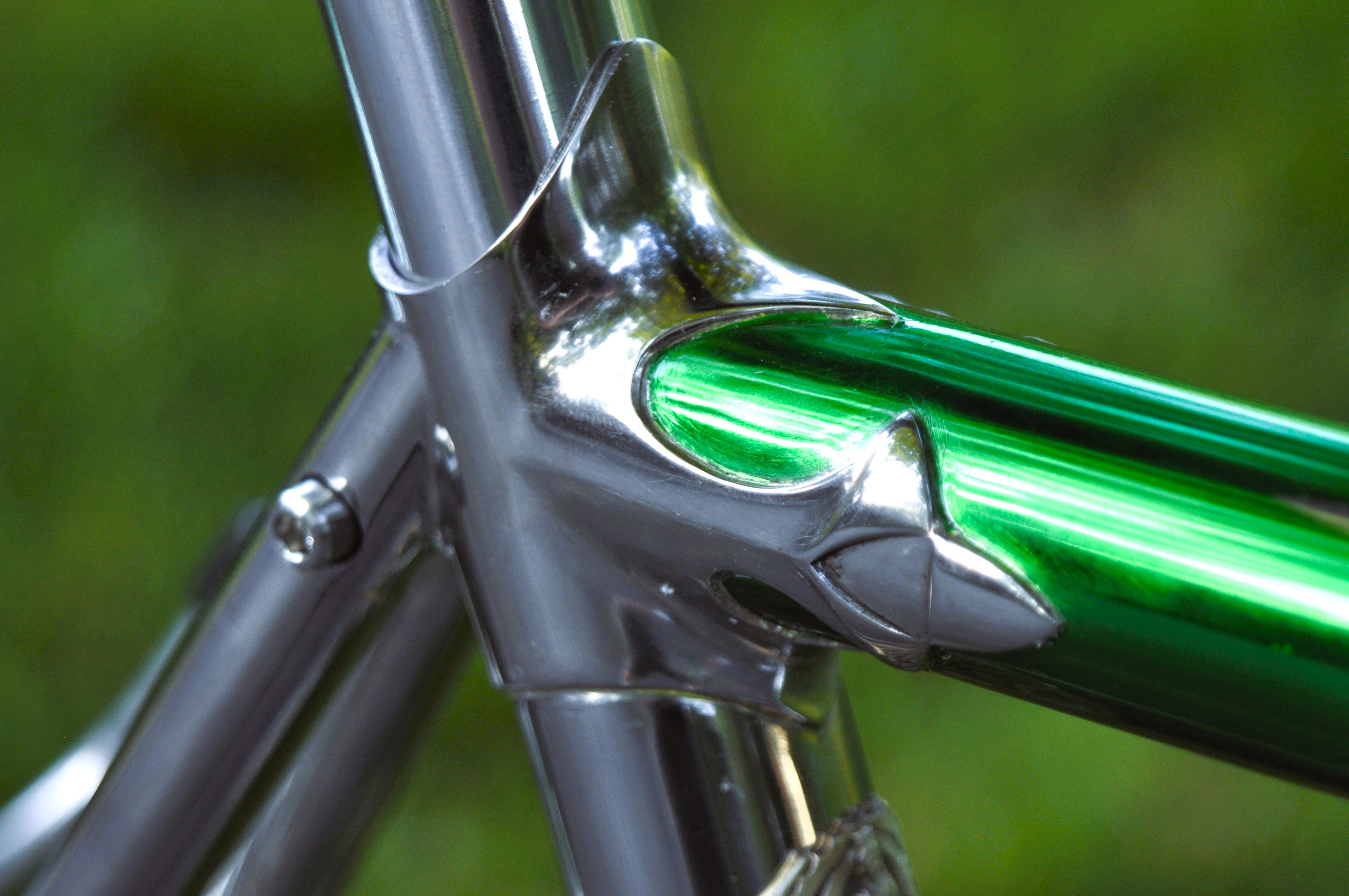
While chrome is not exclusively an Italian thing, I do like shiny. I won’t do chrome, it is not environmentally friendly, so polished stainless was obvious. And no worries about rust. They did have cromoveltato paint, translucent paint on chrome. Chipped horribly back in the day, but the clear primer available today binds much better to polished metal. Fiamme (flame) paint graphics. They would bolt on a lucchetto (lock) to the seat stays, I integrated it as the “brake bridge”. Internally routed brake cables. Fleur di lis lugs were a thing from a manufacturer called Gloria. Maino made a triple-plate fork crown. Cinelli has the seat stay seat pot binder. The hubs are custom made, based on Ercole Baldini’s hubs used for his hour record in the 50s. Branded pedals and stems were a thing in the 40s/50s. Tiered fenders. Bone hand grips. The cranks are vintage with what is called a Gloria ring. Saddle is Brooks, while English back in the day, the C15 on the bike was made in Italy.
Holy fkn bravo. That green over the stainless looks mental. Deserves a longer look at all the photos but mamma mia. Rear fender chainstay mount - what the hell is going on there, combo bridge and most secure fender mount ever?
You must live somewhere flat with that gearing.
Will it Eroica?
Bravo again. I have an old bare Mercier that I’m waiting to get motivated to started on. Thanks/no-thanks for throwing down the benchmark. Bad ass.
Just noticed the Paul stoppers and that the rear dropout cluster actually includes the fender mount, wow. Non rattly fenders and you can maybe actually stop. What are the handlebars, originals??
Thanks for the good words. I really like the paint too. I vowed never to make a polished stainless bike ever again, it is a stupid amount of work. But after the paint, I plan on a third bike, full cromovelato.
Chicago is flat. Also, it is not meant to be ridden for more than 60-90 minutes. Unless time-trialing it, you never get tired, so a hill here and there is not a thing.
The weight without bags or bottle its a skosh over 20 pounds.
Stem, levers and hub flanges are custom milled. Lugs, dropouts, fork crown, stay bridges and wrench are printed stainless. Pedal plates are laser cut. Bags were sewn on a Juki with printed mounting hardware.
Top pic tires are for show, pic with bags are go tires.
The Italians had 100% internal rod brakes, that’s right, rod brakes, by the early 1920s. Why they never had internally routed cables for condorino bars is beyond me. All of them are like the example I posted in the inspiration pics. Seemed obvious to me to rout the cables like I did. Also, I don’t think internal cables would cost more in production.
I considered 114 spacing to have an even dish, but I decided on 120 in case I want to throw on a 5 speed sometime in the future. I doubt it, but not a big thing either.
Yes, a flip-flop hub and will do wicked skids.
I thought a curved rack would be nice instead of straight, then double duties to hold the fender. Since the bags were always going to be custom, attachment was not a concern. Its 12mm stainless, stiff as hell.
Beautiful! I think my favorite part is the brake levers. They way they are integrated with the form is superb. The fleur de lis are also a great detail.
Invisible stuff - what parts did you use for the bottom bracket and headset? Please tell me there are loose balls in there, held in place with Campagnolo beige grease.
You know you just opened the door to a guy who knows too much about vintage Italian stuff? You let out the geek, can’t blame me.
Hubs and BB are by a company called FB, Fratelli Brivio (Brivio brothers). In business from 1920-ish to 1960-ish. To give it a modern-day anchor, they made hubs for Campagnolo from 1933-1953. FB had a patent on 3-piece hubs - steel barrel, aluminum flanges, from 1932-1952. I suspect Campagnolo started making their own 3-piece hubs in 1953 because of the expired patent.
FB was really known for their hubs, they were the 600-pound gorilla in Italy from 1935-1955-ish. They supplied hubs to I suspect hundreds of bike manufacturers, large and small. This is known because FB would stamp their logo and the bike-manufacturer logo on the steel flange. I’m trying to collect them all. I think I stand at about 20 different brands.
I once had a NIB set from 1936. Smoothest hubs I have ever owned, even more so than Phil hubs. Of course loose ball, as with the BB. But with Phil grease, I’m to lazy to track down lithium when the LBS has Phil. Their BBs on the other hand ae kinda crap. The hardening they did on the spindle is crap. The pit very easily. They also made a crank. I have had a few, but not on this bike.
My favorite part of the hubs are the axles. Chromed tips with a dimple. Soo cool.
The end of the spindle is stamped FB. Again, sooo cool. (But these pics are not in the bike, I found a NOS one, never took pics of it, so you get this old one I had).
I forgot, the headset. I know a guy at Cane Creek. He gave me a 1 1/8 threadless stainless steel prototype. Seemed appropriate. Loose ball. Phil grease.
 .